Certificates · DNS · NIS2
Every domain, fully qualified.
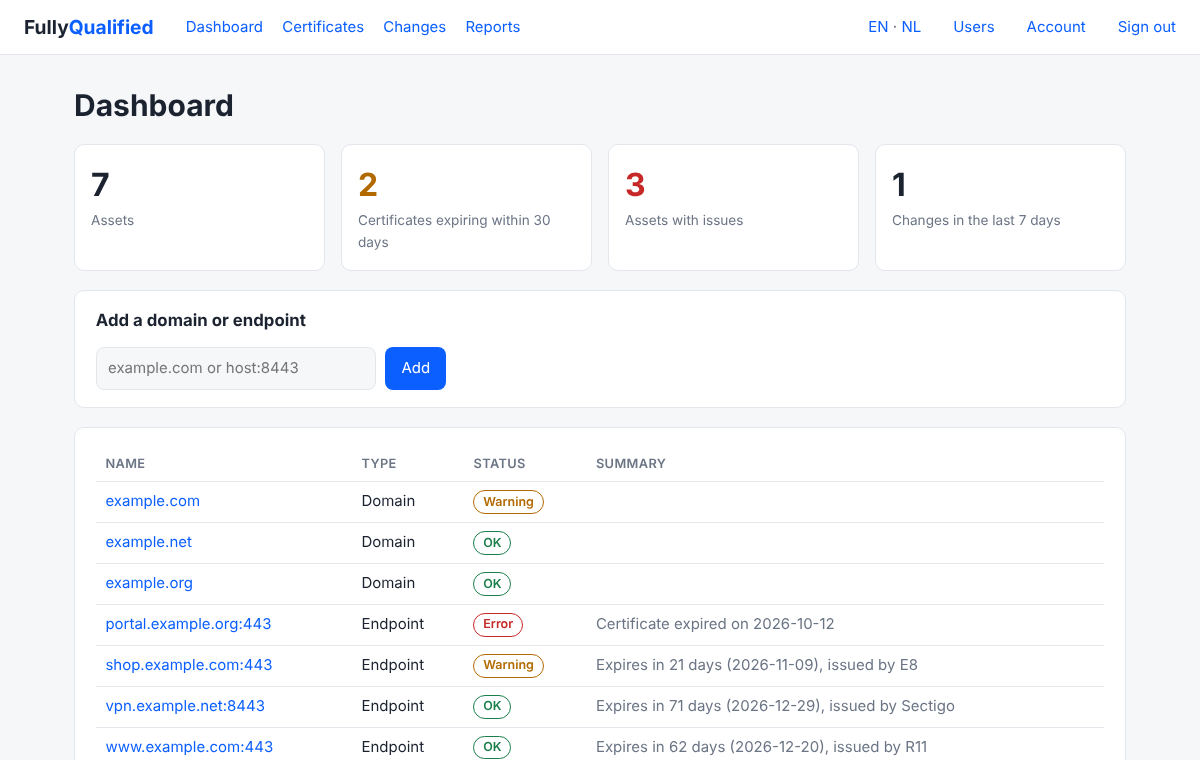
FullyQualified watches the TLS certificates and DNS records of all your domains, tells you the moment something expires or drifts, and turns the results into a NIS2 report.
Open source (AGPL-3.0). It only reads: nothing is ever changed in your environment.
- Open source, AGPL-3.0
- Read-only: never changes your systems
- Self-hosted today, EU-hosted version planned
- Passkey sign-in, roles and single sign-on
Check a domain now
See the TLS certificate and the email and security records of any public domain in a few seconds. No account, nothing stored.
Certificates are getting shorter. Your spreadsheet is not keeping up.
Browsers and certificate authorities are cutting the maximum lifetime of public certificates. What was a yearly chore becomes a monthly one, and a forgotten certificate or a changed DNS record is an outage or a security hole.
100 days
Maximum certificate lifetime from 2027, down from a year.
47 days
Maximum certificate lifetime from 2029. Manual renewal stops being realistic.
NIS2
Requires demonstrable control, also from companies that are suppliers in someone else's chain.
What it keeps an eye on
Add a domain or an endpoint and the checks start. Every value is stored as a baseline, so a change is noticed, recorded and alerted.
Certificates
- Found through Certificate Transparency logs and TLS endpoint scans
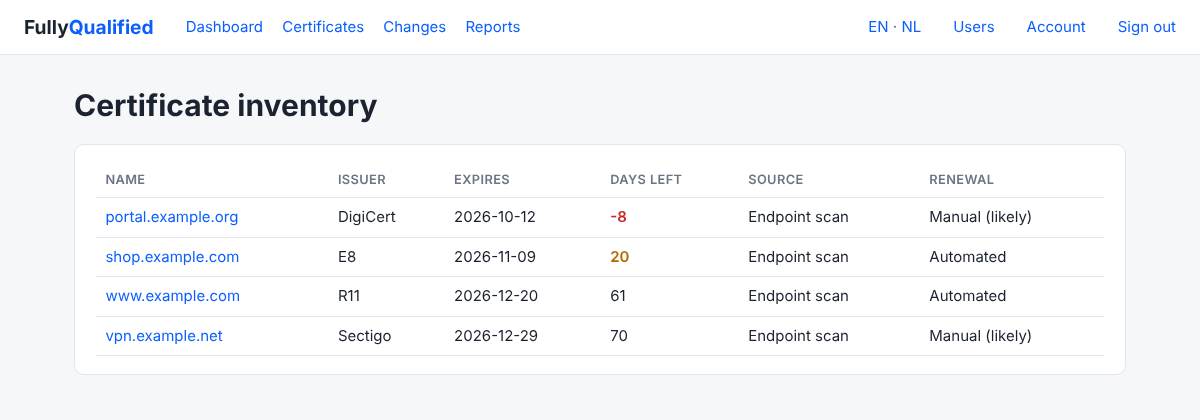
- Expiry, issuer and whether renewal looks manual or automated
- Untrusted, expired and soon-to-expire certificates flagged
DNS
- SPF, DKIM, DMARC, CAA, MX, NS and DNSSEC
- Dangling CNAMEs that allow subdomain takeover
- Any change to a record is a recorded event
Alerts
- Slack, Telegram, a generic webhook (PagerDuty, Opsgenie) or email
- Sent when a status changes or a record drifts
- Dashboard and change history in English and Dutch
Diagnostic toolbox
- Signed-in checks for TLS, mail TLS, SPF, DKIM, DMARC and DNS, also for hosts you do not monitor
- Each check runs once and stores nothing
The report is the point
Auditors and customers do not want a dashboard; they want proof. FullyQualified turns the latest results into a NIS2 report as PDF and Excel: your certificate inventory, your DNS controls per domain, and what changed in the last 90 days.
A report is evidence for the technical part of NIS2, not a compliance certificate. NIS2 covers far more than certificates and DNS.
From zero to first report in minutes
The goal is value within ten minutes of starting.
Add your domains
Type a domain or host:port. Certificates are found by scanning. On request, the public CT logs list more hostnames for you to review.
Read the results
See what expires, what is untrusted and which DNS controls are missing.
Hand over the report
Download the NIS2 report as PDF or Excel, and let alerts catch what changes next.
Self-host it in one command
FullyQualified is one .NET container and a Postgres database. Everything in the repository is open source under the AGPL-3.0, including accounts with passkeys, roles and single sign-on through OpenID Connect.
Then open http://localhost:8080 and create the first account. Cloud connectors, starting with Azure, are on the roadmap.
git clone https://github.com/pimvd/fullyqualified
cd fullyqualified
docker compose up
Hosted plans are planned
Prefer not to run it yourself? A hosted version in the EU, on Scaleway, is planned. Plans are by number of domains. Prices are not set yet.
Free
5 assets
- Certificate and DNS checks
- History: 1 month
Starter
25 assets
- Everything in Free, plus the NIS2 report
- History: 12 months
Business
100 assets
- Everything in Starter, plus cloud connectors and SSO
- History: 24 months
Custom
by agreement
- Limits agreed per customer
Self-hosting stays free with no domain limit.
Questions
Does FullyQualified change anything in my environment?
No. It only reads: public DNS queries, TLS handshakes with the endpoints you add, and Certificate Transparency logs. Changing things, such as automated renewal, is a possible later step and would be opt-in.
What does it check?
TLS certificates (expiry, issuer, trust) and DNS records: SPF, DKIM, DMARC, CAA, MX, NS, DNSSEC and dangling CNAMEs. It records every change against a baseline and alerts you through Slack, Telegram, a webhook or email.
Does the report make me NIS2 compliant?
No. It gives you evidence for the certificate and DNS part of your technical measures. NIS2 compliance is much broader and is your responsibility.
Where does my data live?
When you self-host, on your own server in your own Postgres database. The planned hosted version runs in the EU on Scaleway.
How do people sign in?
With passkeys, so there are no passwords to leak. Single sign-on through OpenID Connect is supported too, and there are three roles: viewer, member and admin. New people join through single-use invitations.
Is it free?
Self-hosting is free and open source under the AGPL-3.0. A paid hosted version is planned; prices are not set yet.
Know what expires before it does.
Star the project, try it on your own domains, or tell us what is missing.